Purpose execution report: what it is and how to build it
What the law requires in the purpose execution report, what counts as proof for each goal and what happens when it falls short, under Law 13,019 and Decree 8,726.

The purpose execution report (in Brazil, "relatório de execução do objeto") is the document in which a civil society organization (OSC) shows the government agency what it did in a public partnership and how much of the goals it reached. Under Law 13,019/2014, it describes the activities carried out and compares the proposed goals with the results achieved, with proof for each one. There is a partial version, for partnerships longer than one year, and a final version. The funding agency's own template takes precedence.
What is the purpose execution report?
It is the core of accountability reporting for a grant agreement ("termo de fomento") or collaboration agreement ("termo de colaboração"). The law requires the OSC itself to prepare the report, covering the activities or projects carried out and a comparison of proposed goals with results achieved (art. 66, I). The financial execution report, with revenue and expenses, is only required when goals were not met (art. 66, II).
The report answers the question the partnership manager asks: was the purpose delivered as agreed? Accountability reporting must include a detailed description of the activities and proof that the goals were reached (art. 64), and the review considers "the real truth and the results achieved" (art. 64, § 3).
Deadlines, review and the final decision on the accounts are covered in our guide to accountability reporting for nonprofits and OSCs.
What is the difference between the partial and the final report?
The partial report follows the partnership year by year, and the final report closes it. In federal partnerships, those lasting more than one year submit a Partial Purpose Execution Report at the end of each 12-month period, counted from the first release of funds (Decree 8,726/2016, art. 59). Its content follows the same rules as the final report.
The Final Purpose Execution Report has the same elements plus two more: proof that any balance left in the account was returned, and the planned reserve for the team's severance costs (art. 62). In a three-year partnership, the OSC writes this report three times.
What does the report need to contain?
Decree 8,726, as amended by Decree 11,948/2024, sets out what the federal report includes (art. 55). In short, the agency expects to find:
- the goals in the work plan, each with the result achieved or the justification for what was missed;
- the actions taken to deliver the purpose;
- proof of the work, "such as attendance lists, photos, videos, among others";
- proof of the matching contribution and of the actions of organizations working as a network, when there are any;
- the economic or social impact, the satisfaction of the people served and whether the work can continue after the partnership.
Each item has its own rule. Impact, satisfaction and continuity can be waived when they are out of proportion to the partnership's complexity (art. 55, § 3). Satisfaction can be shown through other documents when no survey was run (art. 55, § 5). The federal template also asks for a section on the partnership's transparency.
States and municipalities have their own decrees, and the agency gives the OSC a specific manual when the partnership is signed (Law 13,019, art. 63, § 1). Each agency builds the report its own way, with fields, attachments and requirements that change from one agreement to the next.
What counts as proof for each goal?
The work plan decides what counts as proof. It sets the parameters for measuring each goal (Law 13,019, art. 22, IV) and, in federal partnerships, the indicators, documents and other means of verification (Decree 8,726, art. 25, IV).
This is where the report usually gets heavy. Each goal needs its own proof, and that proof has to exist from the day of the activity: signed attendance lists, dated photos, videos, certificates, promotional material, audience counts. When the team only goes looking for it at the end of the partnership, some of it is already lost, and what is left has to be gathered, checked and tied to the right goal.
In a partnership with several goals over a year or more, those files end up scattered across people, phones and folders.
If your team only gathers this proof on the eve of the deadline, talk to us. Transparência360 keeps each partnership published with its goals, documents and accountability status throughout the work, and that history stays in place for the next partnerships.
What happens to a goal that was not met?
The decree requires the OSC to justify any goal not reached (art. 55, § 4), and the law requires disallowing the amounts tied to goals missed "without sufficient justification" (art. 64, § 1). The justification is what separates a partially met goal from returning money.
A weak justification, without proof of the reason, can turn a partially met goal into an amount to be returned. When the agency's monitoring finds partial non-performance during the partnership, the OSC is notified and has 30 days to fix or justify it (Decree 8,726, art. 51-A, § 1).
What does the agency look for in the report?
In federal partnerships, the manager issues a final technical opinion that checks whether the purpose was delivered and the goals were reached. It considers the final report, the partial reports, and the site visit and monitoring reports, when available, and evaluates the partnership's effects: impact, satisfaction and continuity (art. 63).
If the review shows a missed goal or a sign of irregularity, the manager asks the OSC to submit the Final Financial Execution Report before the opinion (art. 64). An incomplete purpose report opens the door to that second report, with invoices, statements and cost-sharing for each expense.
Accounts cannot be rejected based only on the assessment of impact, satisfaction and continuity (art. 66, § 4). What decides is the purpose and the goals. Rejected accounts lead to the return of funds and, without it, to a special accounts audit ("tomada de contas especial").
Why does the report ask about the OSC website?
The federal template has a section called "Transparency", which asks how the partnership was made public. Decree 8,726 requires the OSC to publish on its website and in a visible place at its offices the information listed in article 11 of the MROSC, from the signing of the partnership until 180 days after the final accountability report (art. 80). That includes the purpose, amounts and accountability reporting status.
When the money comes from a parliamentary amendment, the template warns that this section needs extra information, as the agency directs. This follows the Supreme Court decisions in ADPF 854, which require publishing the amounts received and spent.
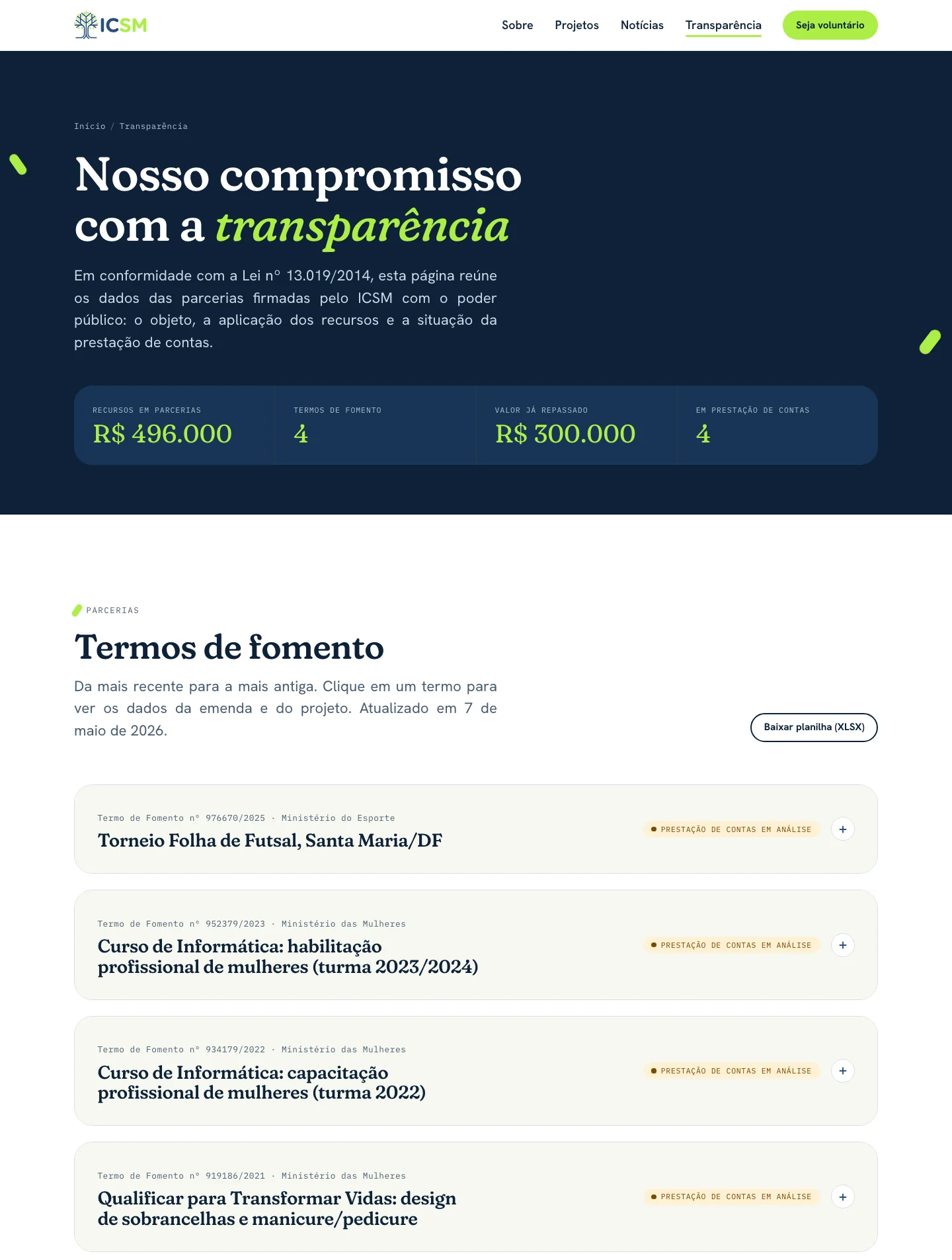
The section is easy to fill when the partnership is already online. The ICSM portal shows four partnerships, totaling R$ 496 thousand in grant agreements, each with its own status. The Instituto NEXA portal publishes R$ 3.1 million in parliamentary amendments, with amount, transfer and documents.
Frequently asked questions
Is there an official purpose execution report template?
For federal partnerships, Transferegov.br publishes a template (in Portuguese) as Annex VI of the MROSC Manual. States, municipalities and many agencies have their own template, usually in the call for proposals, the agreement or the manual handed over at signing. The template of your partnership's agency always applies.
Do I need to attach invoices to the purpose execution report?
Under the law and the federal decree, no. Invoices, receipts, bank statements and the cost-sharing calculation belong to the financial execution report, which is only required when a goal was missed without justification or there is a sign of irregularity (Decree 8,726, arts. 56 and 64). In federal partnerships, the agency pulls that report from Transferegov.br itself. Local rules may ask for more.
Who signs the report?
In the federal template, the report is signed by the OSC's director, with city and date. Your agency's manual may ask for another signature, such as the technical lead's.
Do I have to send again what is already on the platform?
Not in the federal final report. Documents proving the purpose and the matching contribution that are already on the platform are waived (Decree 8,726, art. 62, sole paragraph).
What if the OSC did not run a satisfaction survey?
The federal decree accepts a statement from a local public or private organization, an opinion from the sector council or another document showing how satisfied the people served were (art. 55, § 5).
Key takeaways
- The purpose execution report is prepared by the OSC and describes the activities carried out and compares goals with results.
- Partnerships longer than one year submit a partial report each year. The final report closes the partnership with the same elements plus the return of the balance.
- Each agency has its own template, fields and attachments. Your agency's template takes precedence.
- The work plan defines what counts as proof for each goal, and that proof has to exist from the day of the activity.
- A goal missed without sufficient justification can have its amount disallowed.
This post summarizes the law and the federal decree as currently in force and does not replace the funding agency's manual. Confirm with the agency and the organization's legal advisors what applies to each partnership.
The next accountability report starts ready
The organization's own team writes the purpose execution report. Travazaga builds what makes this accountability report, and every one after it, lighter: the NGO website, the Transparência360 transparency portal and the system integrated with Transferegov. Each partnership is published with its purpose, amounts, goals, documents and accountability status, at an address the agency can check. The history of past partnerships stays in the portal, so the team does not start from scratch with each new agreement. If your organization does not have a website yet, we build the NGO website with the portal built in.
Want to know what your organization still needs to publish? The assessment takes 15 minutes and is free.