Accountability on Transferegov: step-by-step guide for OSCs
What an OSC has to record on Transferegov.br during the partnership, the deadlines at the end and where accountability reporting usually gets stuck.

A civil society organization (OSC) with a federal grant or collaboration agreement reports its accounts on Transferegov.br, in the Discretionary and Legal Transfers module ("Transferências Discricionárias e Legais"). Accountability reporting starts with the first payment: purchases, contracts, payments and proof of activities go into the platform throughout the partnership. At the end, the OSC has 30 days to return the balance and submit the final purpose execution report, and only then sends everything for review. This guide covers what the platform requires and where organizations usually get stuck.
Where does the OSC report its accounts on Transferegov?
Transferegov.br is the federal government platform for transfers of federal funds. It grew out of Siconv, created in 2008, which became Plataforma +Brasil in 2019 and took its current name with Decree 11,271/2022. Any manual, tutorial or guidance that mentions Siconv or Plataforma +Brasil refers to the same system, although the screens may have changed.
In federal partnerships under the Regulatory Framework for Civil Society Organizations (MROSC, Law 13,019/2014), using Transferegov.br is mandatory, including partnerships funded by parliamentary amendments (federal MROSC Manual, August 2025). Decree 8,726/2016, as amended by Decree 11,948/2024, requires the purpose execution report to be submitted on the platform itself. Deadlines, required reports and how accounts are judged are covered in the complete guide to OSC accountability reporting.
What does the OSC need before logging in?
Access to the module requires a gold-level gov.br account, according to the official tutorials. Without that level, the user cannot log in.
Then come the user profiles. The official tutorials describe five user profiles linked to the OSC, each handling one part of the work: the agreement manager, the financial manager, the expense authorizer, the committee that handles price quotes and the accountability report filer. The financial manager and the expense authorizer must be different people, according to the Ministry of Sport's support material for grant agreements (July 2026).
In practice, a small OSC needs at least two people with access, a gold account and the right profile before the first payment. When someone leaves the team mid-partnership, payments can stop until another person is registered.
What does the OSC record on Transferegov during the partnership?
Almost everything that happens with the partnership's money goes through the platform, as it happens:
- the prior price quote for each purchase;
- contracts with suppliers and staff;
- the settlement document for each expense, such as an invoice, receipt or payroll;
- each payment, which one profile enters and another authorizes;
- photos, attendance lists and other documents proving the activities;
- the use of income earned on invested funds;
- work plan adjustments and amendments to the agreement;
- replies to the agency's requests for clarification.
Three rules explain why these records carry so much weight:
- Payments go out through the platform. The partnership account is operated on Transferegov.br, through the Partnership Payment Order (OPP) or another platform method (Decree 8,726, art. 38).
- The invoice does not need to be uploaded, but it must exist. The decree waives uploading invoices and receipts when payment is made on the platform (art. 37, § 1). Originals are kept for 10 years.
- Without an active settlement document, the payment does not go out. The Ministry of Sport's guide says to check that status before requesting the transfer of funds.
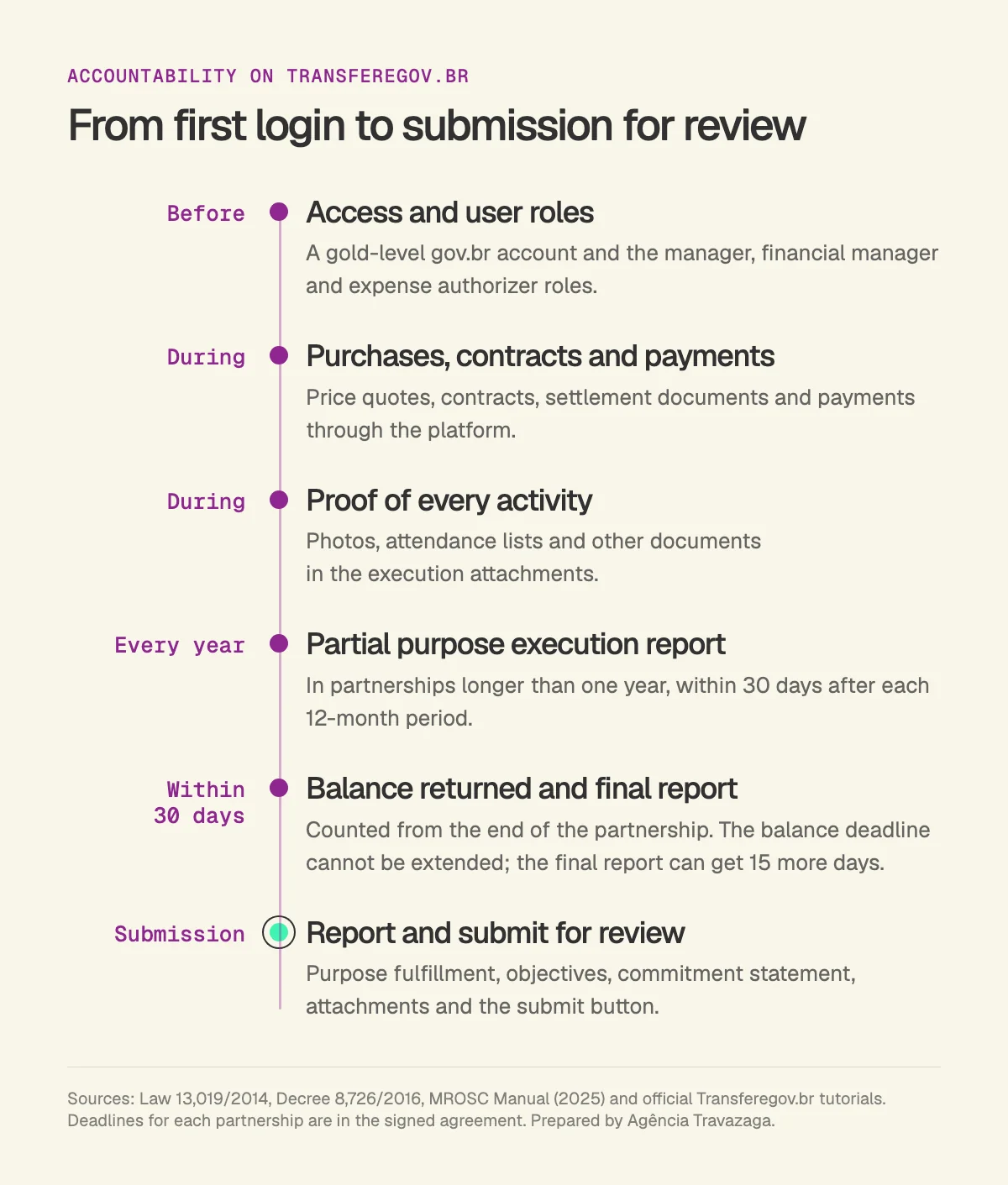
Each agency may ask for its own documents, and the agreement and the agency's manual say what applies to your partnership.
Where do OSCs usually get stuck?
The points below come from the rules and the official tutorials. They are the places where one stalled detail holds up everything else:
- Access and profiles. A gov.br account below gold level, a missing profile, or the same person trying to enter and authorize a payment.
- Records left for the end. Each purchase needs a quote, a contract, a settlement and a payment, in sequence. Months of accumulated expenses become a queue of entries on the eve of the deadline.
- Old names. Tutorials from different years call the same screens by different names, from Siconv to Transferegov.
- Proof of activities outside the system. Photos and attendance lists saved on a team member's phone, undated and not tied to any goal.
- Two 30-day deadlines at once. At the end, returning the balance and the final report run together, and the balance deadline cannot be extended.
Final submission goes through 10 stages in the official tutorials, including execution reports, internal approvals, tabs to fill in, the return of the balance and attachments. One incomplete stage blocks submission.
Is your partnership stuck at one of these stages? Travazaga builds transparency portals and systems integrated with Transferegov, which keep the partnership's information organized from day one. Talk to us and tell us about your organization's case.
How does annual reporting work?
A partnership longer than one year has accountability reporting every 12 months, counted from the first release of funds. The OSC submits the Partial Purpose Execution Report on the platform within 30 days after the end of each period (Decree 8,726, art. 59). If it does not, the partnership manager sends a notice, and the OSC has 15 days to submit.
The content is the same as the final report (art. 55): goals reached or justified, actions taken and proof of the work, such as attendance lists, photos and videos. In a three-year partnership, that means two partial reports before the final one.
What does the OSC have to submit at the end of the partnership?
At the end, two deadlines run together. Any balance left in the account, including income earned, goes back to the agency within 30 days, with no extension (Law 13,019, art. 52). The Final Purpose Execution Report is due within 30 days after execution ends, extendable by 15 with a justified request made in advance (Decree 8,726, art. 65).
The submission brings together the execution reports generated on the platform, the statement that the purpose was delivered, a description of the objectives reached, the commitment form, the return of the balance authorized by two profiles and the attachments proving the work. It also includes the calculation of the reserve for severance costs, when there is one (MROSC Manual, item 9.4).
If the report is not submitted on time, the partnership is in default of the duty to report, one of the grounds for rejecting the accounts under the law.
What happens after submission?
The partnership manager issues a final technical opinion on the platform itself. If a goal was missed or there is a sign of irregularity, the manager extracts the financial execution report from Transferegov.br or asks the OSC to submit it within 60 days (MROSC Manual, item 9.4). That is why every payment recorded correctly during the partnership weighs on the final review. Rejected accounts lead to the return of funds and, without it, to a special accounts audit ("tomada de contas especial"). Review deadlines and possible outcomes are in the accountability reporting guide.
What if the partnership came from a parliamentary amendment?
Reporting on the platform is the same. Transparency changes. Since the Supreme Court (STF) decisions in ADPF 854, the OSC must publish on its own website the data on partnerships funded by amendments signed since 2020 to access the funds, according to the amendments manual for OSCs published by Transferegov.br. The MROSC Manual also requires the name of the amendment's author, its type and where the funds were spent.
The Instituto NEXA portal publishes R$ 3.1 million in parliamentary amendments with amounts, transfers and documents. The ICSM portal shows each grant agreement with its accountability status.
Frequently asked questions
Do I need to upload invoices to Transferegov?
No, when payment is made on the platform. Decree 8,726 waives uploading invoices, vouchers and receipts in that case (art. 37, § 1). The OSC must still obtain the supplier's invoice, with date, amount and both parties' details, and keep the original for 10 years.
How many people at the OSC need access?
At least two, because the person who enters a payment and the person who authorizes it must be different. The official tutorials describe five profiles in total, and all of them require a gold-level gov.br account.
Where are the official manuals?
On the Transferegov.br manuals page (gov.br/transferegov), Discricionárias section, organized by stage. The federal MROSC Manual is in the same area, and the agency behind your partnership may have its own guide.
The platform froze or does not show the option. What should I do?
Call the Transferegov.br Service Center at 0800 978 9008, Monday to Friday, 8 a.m. to 6 p.m. Also notify the partnership manager through the platform's clarification channel, so the problem is on record.
Key takeaways
- An OSC with a federal partnership executes and reports on Transferegov.br, with a gold-level gov.br account and up to five user profiles.
- Purchases, contracts, settlement documents and payments go into the platform throughout the partnership.
- A partnership longer than one year has a partial purpose execution report every 12 months, due within 30 days.
- At the end, the balance goes back within 30 days, with no extension, and the final report is due within 30 days, extendable by 15.
- Final submission goes through 10 stages, and one incomplete stage blocks the accountability report.
This guide summarizes the law, the federal decree and the official tutorials published up to July 2026. Screens change as the platform is updated. Confirm with the funding agency and the organization's legal advisors what applies to each partnership.
The next accountability report starts ready
The organization's own team does the accountability reporting on Transferegov. Travazaga builds what makes this one, and every one after it, lighter: the NGO website, the Transparência360 transparency portal and the system integrated with Transferegov. Each partnership is published with its purpose, amounts, goals, documents and accountability status, at an address the agency can check. The history of past partnerships stays in the portal, so the team does not start from scratch with each new agreement. If your organization does not have a website yet, we build the NGO website with the portal built in.
Want to know what your organization still needs to publish? The assessment takes 15 minutes and is free.