ADPF 854: what changes for NGOs that receive parliamentary amendments
What the Supreme Court ruling requires from NGOs that receive amendments, what happens to those who do not publish and how to prepare so the next transfer does not stall.
ADPF 854 is the case at Brazil's Supreme Court (STF) that struck down the so-called secret budget and, since 2024, sets the transparency rules for parliamentary amendments. For NGOs, the practical effect is direct: any organization that receives an amendment must publish online how much it received and how it was spent, and failing to do so can block the transfer.
What ADPF 854 is
ADPF stands for "arguição de descumprimento de preceito fundamental", a type of lawsuit that brings to the Supreme Court a government practice considered contrary to the Constitution. ADPF 854 challenged rapporteur amendments, known as the secret budget, through which money was distributed without showing who requested it or where it went.
On December 19, 2022, the Supreme Court ruled the secret budget unconstitutional, by 6 votes to 5, with Justice Rosa Weber as rapporteur. The case stayed open as a monitoring process and, under Justice Flávio Dino, came to cover the transparency and traceability of all parliamentary amendments.
Why the ruling reached NGOs
A large share of parliamentary amendments reaches people through civil society organizations: institutes, associations and foundations that run projects with public money. To trace an amendment to its end, the Court also had to look at who receives it.
In August 2024, Justice Flávio Dino ordered NGOs and third sector entities to publish online the amendment funds they received from 2020 to 2024 and how they were spent. The same ruling gave the Office of the Comptroller General (CGU) 90 days to audit these transfers, and the full Court upheld it.
What the NGO must publish
The rule that applies to amendments today is Joint Ordinance MPO/MF/MGI/SRI-PR 2, of April 23, 2025, which governs how amendments are executed. It lists as a technical impediment "not publishing online the amounts received and spent since 2020 in the case of parliamentary amendments to private nonprofit entities".
This requirement adds to duties the NGO already had:
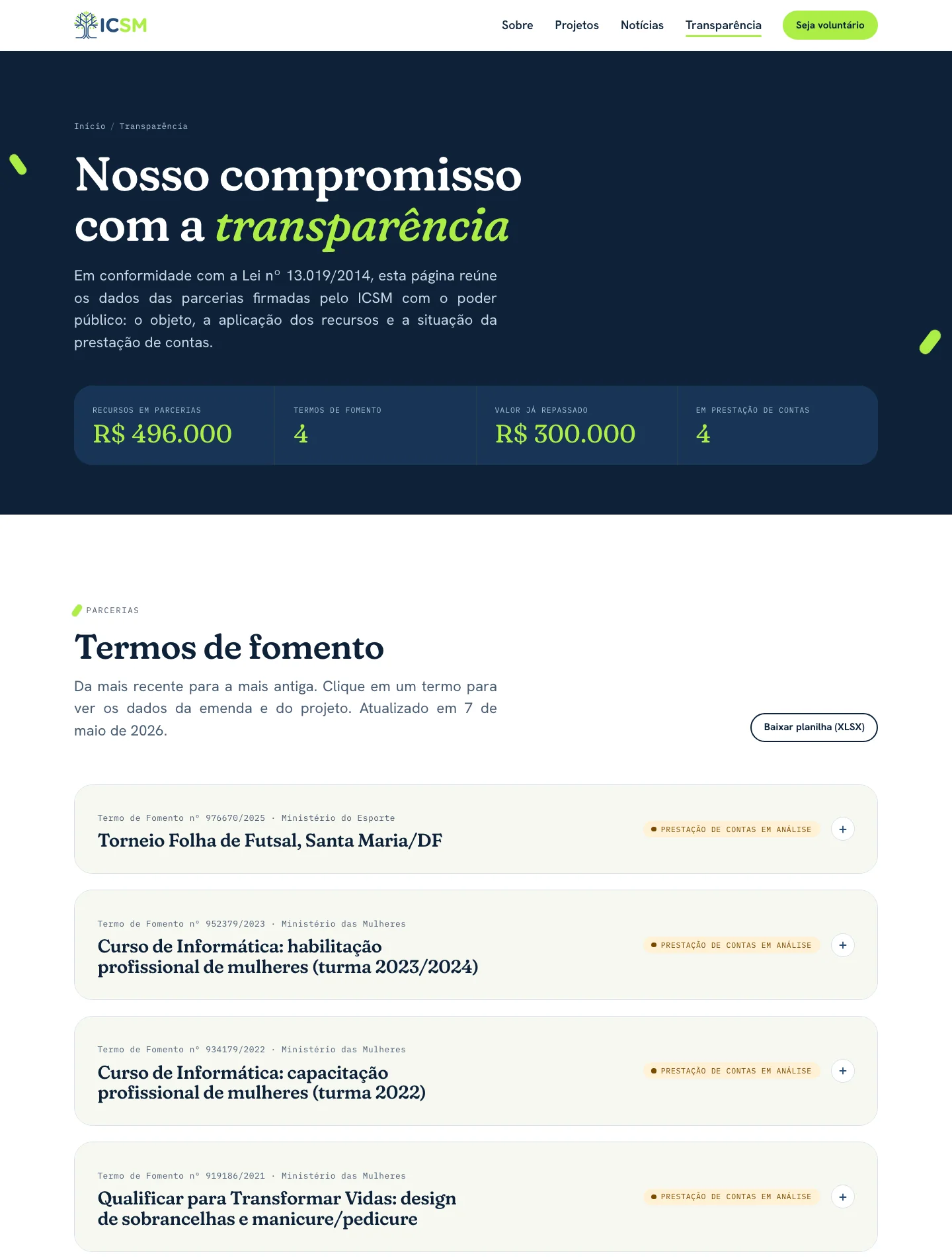
- Law 13,019/2014 (MROSC), art. 11: publish online and at the headquarters every partnership with the government, from signing until 180 days after the final accountability report, with date, agreement, agency, purpose, amounts and the status of the accountability report.
- Decree 7,724/2012, art. 63: publish on the website the bylaws, the list of board members, copies of the signed agreements and the final accountability reports.
- Complementary Law 210/2024: rules for proposing and executing amendments, with transfers recorded on Transferegov.
In practice, the organization's website must show each amendment and each partnership with the amount received, the amount spent, the purpose, the period and the documents, at an address the oversight body can open and check.
What happens to those who do not publish
The consequence has already shown up. On January 3, 2025, the Supreme Court suspended amendment transfers to 13 entities that the CGU found lacking adequate transparency, out of 26 organizations reviewed. Nine others, with incomplete or outdated data, got ten days to comply. Entities that later proved publication had their transfers released.
Since Joint Ordinance 2/2025, the lack of publication is also treated as a technical impediment to executing the amendment. Without the information online, the funds can stall halfway, even with the project approved.
How to prepare for the next amendment
- List every amendment received since 2020. The Transferegov dashboard lets you export the organization's transfers.
- Publish, for each one, the amount received and how it was spent, with purpose, period and supporting documents.
- Bring the MROSC partnerships into the same place, including municipal and state ones, which sit outside Transferegov.
- Use a stable address on the organization's website, one you can send to the agency with no explanation needed.
- Decide who updates it and when. An abandoned page, with data from years ago, gives the same impression as no transparency at all.
- Notify the agency with the links once the publication is complete.
Each agreement and each agency may ask for specific details. Confirm with the granting agency and with the organization's legal advisor what applies to each partnership.
Timeline
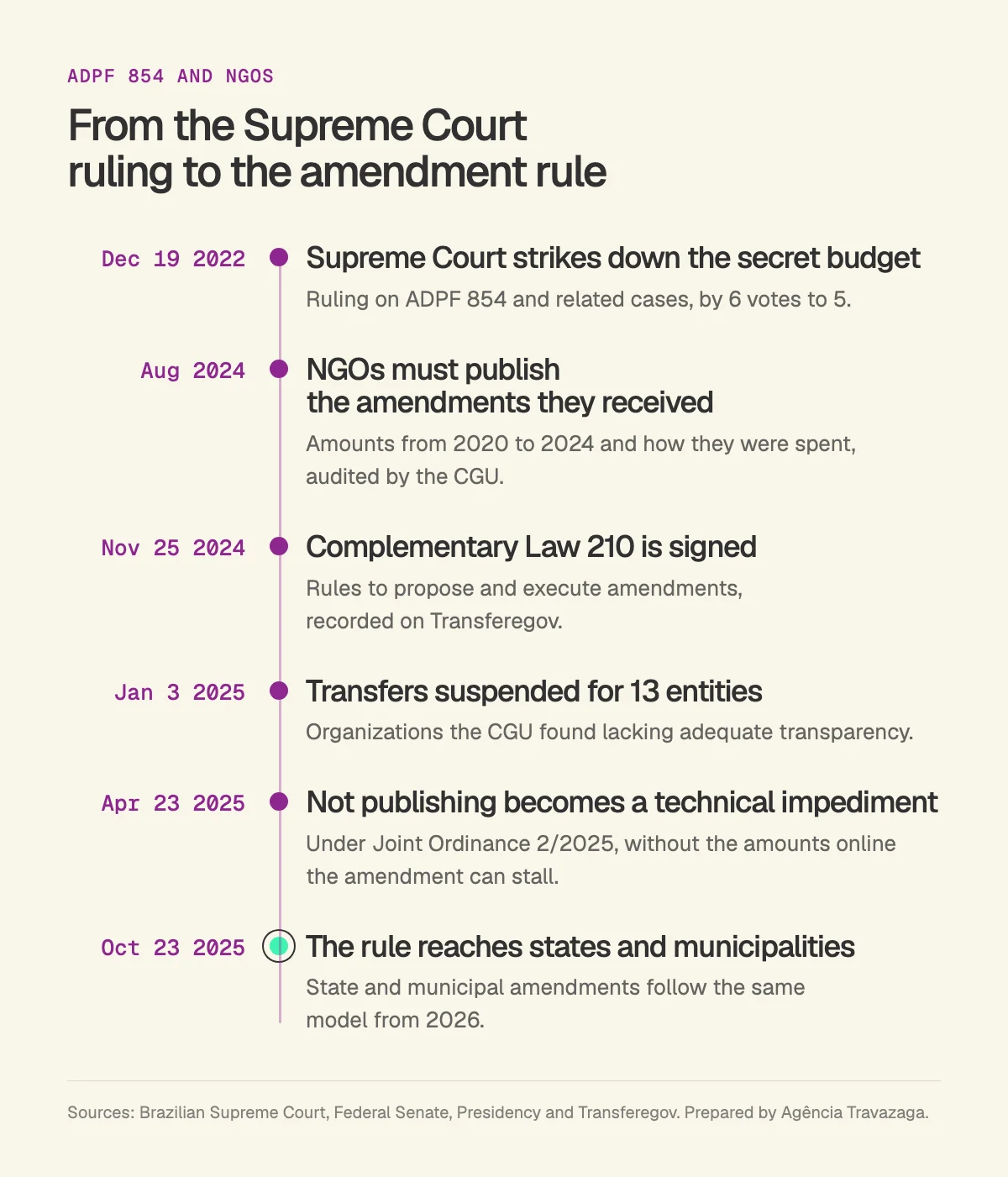
- 12/19/2022: the Supreme Court rules the secret budget unconstitutional.
- August 2024: NGOs must publish online the amendments received from 2020 to 2024 and how the funds were used; the CGU audits.
- 11/25/2024: Complementary Law 210 is signed, with rules for amendments.
- 01/03/2025: transfers suspended for 13 entities without transparency.
- 04/23/2025: Joint Ordinance 2 treats the lack of publication as a technical impediment.
- 10/23/2025: the federal transparency model is extended to amendments from states, the Federal District and municipalities, effective January 1, 2026.
Key points
- ADPF 854 is the Supreme Court case that struck down the secret budget and now guides the transparency of all parliamentary amendments.
- An NGO that receives an amendment must publish online the amounts received and spent since 2020.
- Without that publication, the amendment can stall: Joint Ordinance 2/2025 treats it as a technical impediment.
- This duty adds to article 11 of the MROSC and article 63 of Decree 7,724/2012, which already required partnerships to be published on the organization's website.
- A transparency area on the organization's own website, updated with each partnership, meets the requirement and serves as proof during an inquiry.
Transparency without redoing everything for each amendment
Transparência360 publishes each amendment and each partnership on the organization's website, with purpose, amounts, goals, execution and documents, at an address the agency can check. The team updates one place. If your organization does not have a website yet, we build the NGO website with the portal built in.
Want to know what your organization still needs to publish? The assessment takes 15 minutes and is free.