Accountability reporting for NGOs in Brazil: a complete guide to public partnerships
What a Brazilian NGO submits, by when, and how the agency reviews accountability reports for grant and collaboration agreements under Law 13,019.

Accountability reporting (in Brazil, "prestação de contas") is the procedure in which a civil society organization (OSC) shows the government agency that it delivered the purpose of a public partnership and reached the goals of the work plan. Under Law 13,019/2014, the organization submits the purpose execution report within 90 days after the partnership ends, and the agency decides within 150 days whether to approve, approve with reservations or reject the accounts. The exact deadline for each partnership is in the signed agreement.
What is accountability reporting for a partnership?
Law 13,019/2014, known as the Regulatory Framework for Civil Society Organizations (MROSC), defines accountability reporting as the procedure that checks whether the purpose of the partnership was delivered and the planned goals and results were reached. It applies to grant agreements ("termo de fomento") and collaboration agreements ("termo de colaboração"), the two kinds of partnership that transfer public money.
The process has two phases. In the first, the OSC submits its accounts. In the second, the government agency reviews them and issues a final decision, without prejudice to the work of oversight bodies.
The review centers on results. The law tells the agency to consider "the real truth and the results achieved" (art. 64, § 3). The question the partnership manager asks is whether the purpose was delivered as agreed, and only then, if there is a reason, how each real was spent.
Which reports does the OSC submit?
The law provides for two reports (art. 66), with different roles:
- Purpose execution report, always. The OSC writes it, describing the activities carried out and comparing the proposed goals with the results achieved.
- Financial execution report, only when something went wrong. It lists revenue and expenses and how each one relates to the purpose. The law requires it when goals and results in the work plan were not met.
For federal partnerships, the rule became clearer in 2024. With Decree 11,948/2024, Decree 8,726/2016 now states that the OSC submits the purpose execution report on the Transferegov.br platform. The report brings together:
- proof that the goals were reached, or the justification when they were not;
- a description of the actions taken to deliver the purpose;
- documents proving the work, "such as attendance lists, photos, videos, among others";
- proof of the matching contribution, when there is one;
- information on the economic or social impact, the satisfaction of the people served and whether the work can continue after the partnership.
In the federal process, the agency itself pulls the financial report from Transferegov.br, and only when a goal was missed without justification or there is a sign of irregularity (art. 56 of the decree). That is why recording expenses correctly on the platform, during the partnership, matters as much as the final report.
What is the deadline?
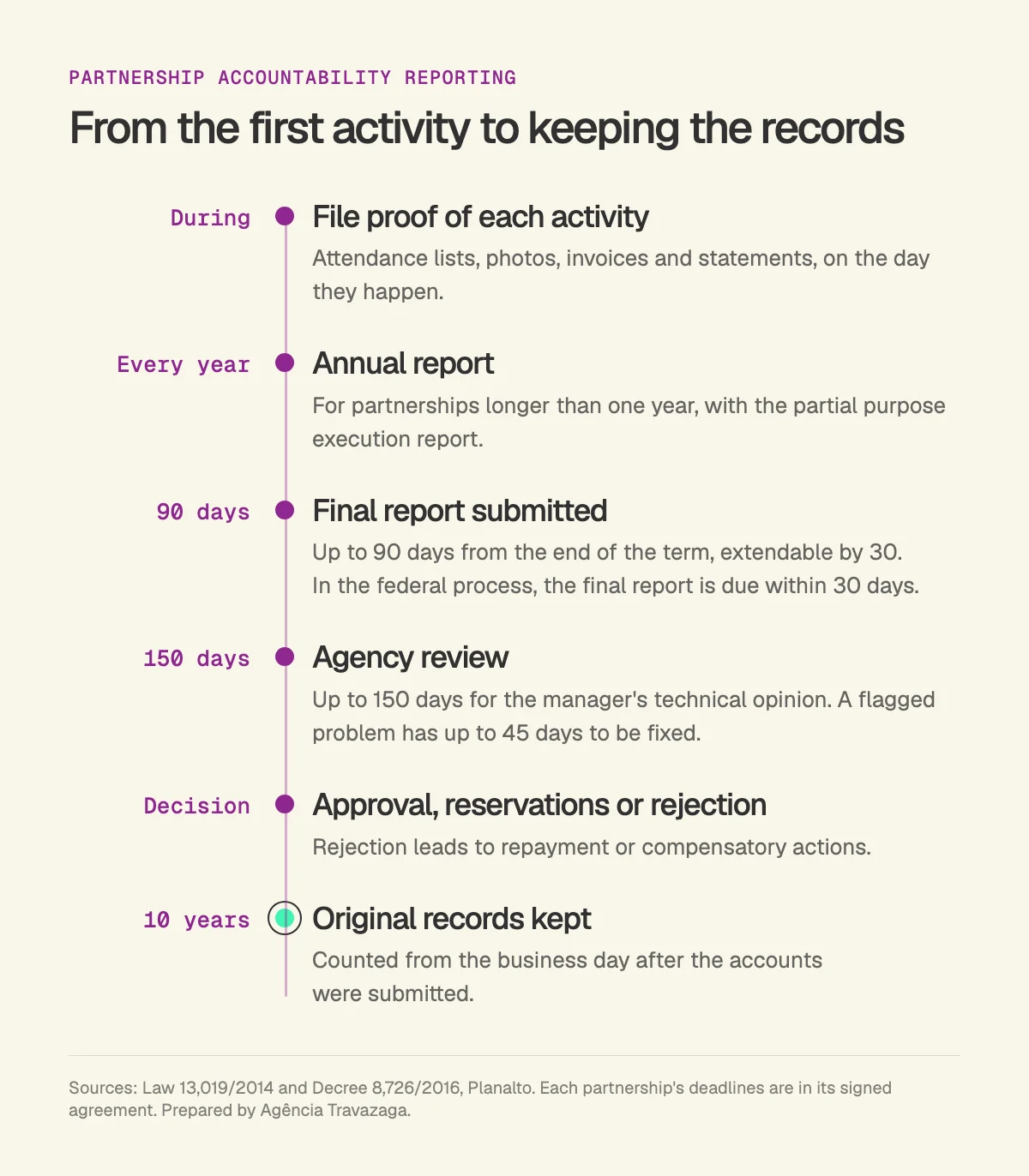
The law gives up to 90 days from the end of the partnership term, extendable by up to 30 days with justification (art. 69). Partnerships longer than one year also report at the end of each year. The agreement may set a shorter deadline, depending on how complex the purpose is, and the federal process sets its own deadlines.
| Step | General rule (Law 13,019) | Federal partnerships (Decree 8,726) |
|---|---|---|
| Final accountability report | Up to 90 days after the term ends, extendable by up to 30 | Final purpose execution report within 30 days after the end, extendable by up to 15 |
| Partnership longer than one year | Report at the end of each year | Partial report within 30 days after each 12-month period, counted from the first transfer |
| Financial report, when requested | As set in the agreement | Within 60 days of notice, extendable by up to 15 |
| Fixing a problem flagged by the agency | Up to 45 days per notice, extendable once by the same period | Same as the law |
| Agency review of final accounts | Up to 150 days, extendable by the same period | Up to 150 days, extendable, capped at 300 |
States and municipalities regulate the law with their own decrees, and the agency must give the OSC a specific manual when the partnership is signed (art. 63, § 1). Before counting days, open the agreement and the agency's manual: that is where the deadline for your partnership is.
How does the agency review the accounts, and what can it decide?
The partnership manager issues a technical opinion based on the purpose execution report and, when available, on site visit and monitoring reports. If they find a problem or something missing, they notify the OSC, which has up to 45 days to fix it, extendable once by the same period (art. 70).
The final decision has three outcomes (art. 69, § 5, and art. 72):
- Approval, when the accounts clearly show the objectives and goals were met.
- Approval with reservations, when there is a formal flaw that did not cause loss to the public treasury. In the federal process, also when a financial irregularity is small and there was no bad faith.
- Rejection, when the OSC failed to report, missed goals without justification, caused loss to the treasury through illegitimate or uneconomical management, or diverted funds.
The agency has up to 150 days to review the final accounts. If that time passes without a review, the agency can still review later. Without intent by the OSC, no interest accrues on any debt during the delay (art. 71, § 4). In federal partnerships, the agency's delay does not stop the OSC from taking part in new calls and signing new partnerships (Decree 8,726, art. 69, § 2).
What happens if the accounts are rejected?
In the federal process, the OSC can appeal within 30 days or fix the problem within 45 days. If the rejection stands, it is notified to return the funds tied to the irregularity. If there was no intent or fraud, it can ask to make amends through compensatory actions of public interest, under a new work plan (art. 72, § 2, of the law).
Without repayment or compensation, the agency opens a special accounts audit ("tomada de contas especial") and records the rejection on the electronic platform. The flaws behind a rejection are recorded on a public platform and count against future partnerships (art. 69, § 6).
Running the partnership outside the work plan can also lead to sanctions: a warning, a suspension of up to two years from new partnerships with the level of government that imposed it, or a declaration of unfitness (art. 73). Penalties expire after five years, counted from the date the accounts were submitted.
Which documents must the OSC keep?
Proof for accountability reporting builds up over the whole partnership. Based on what Decree 8,726 asks for, the organization gathers documents on three fronts: delivering the purpose (work plan, amendments, attendance lists, photos, videos, proof of the satisfaction of the people served and of the matching contribution), the finances (invoices, receipts, payslips, statements from the dedicated bank account, cost sharing and goods acquired) and the justification for every goal that changed along the way.
Original documents must be kept for 10 years, counted from the business day after the accounts were submitted (art. 68 of the law and art. 58 of the decree). A two-year partnership produces records the organization still has to find more than 12 years after signing the agreement. With several partnerships at once, each with its own agency and manual, that archive multiplies, and proof tends to get lost when staff change, on the phone of whoever took the photos or in a folder nobody can find.
A transparency portal keeps each partnership at its own address, with documents, amounts and accountability status, and that history is still there when the next partnership arrives. That is what Transparência360 does on the organization's website.
What must the OSC's website show about accountability reporting?
Article 11 of the MROSC requires the OSC to publish online and at its offices every partnership with the government. The minimum information includes the status of each partnership's accountability report: the date it is due, the date it was submitted, the review deadline and the final result. The signing date, agency, purpose, total amount and amounts released, and the pay of staff funded by the partnership are also required.
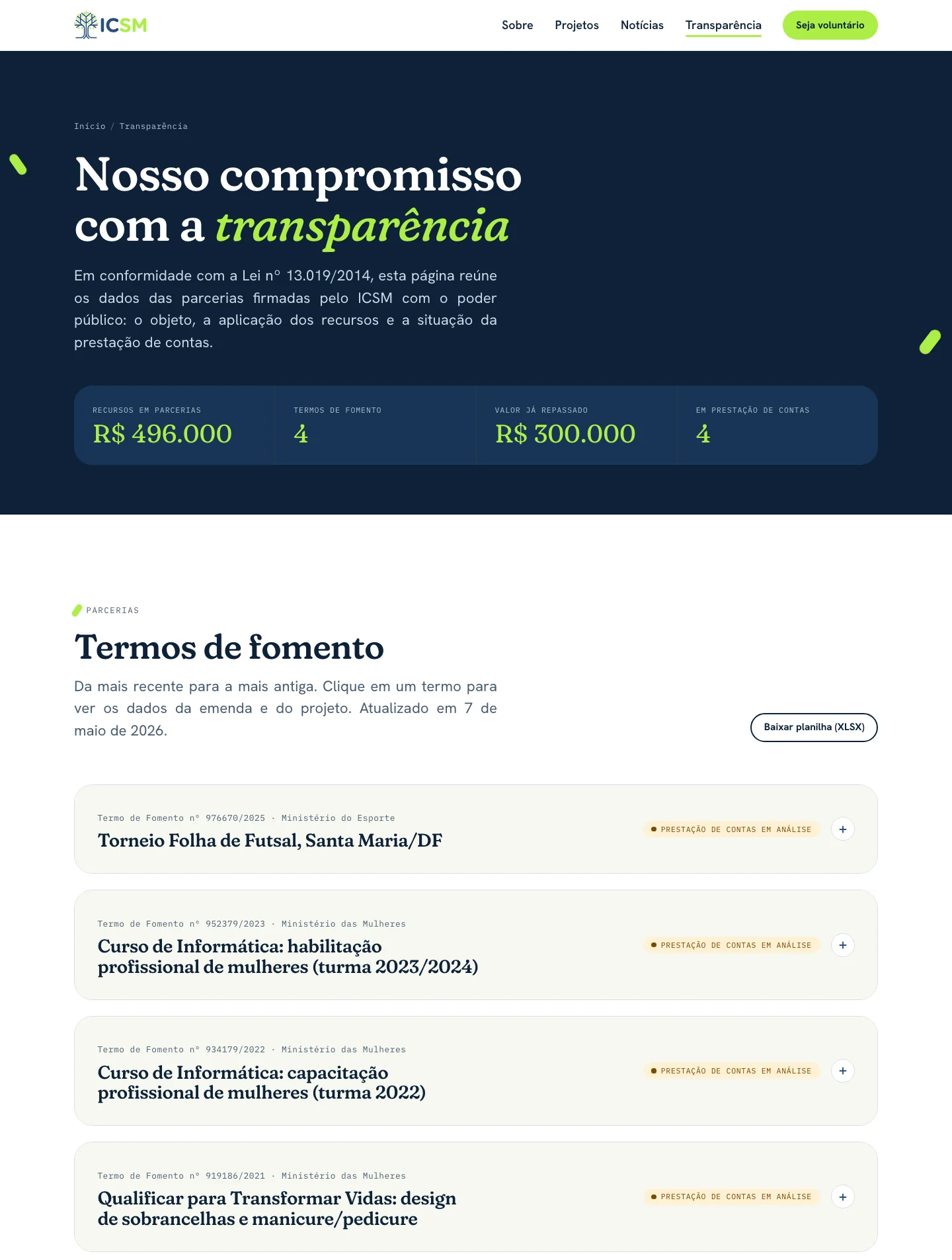
An organization that already keeps its accountability reporting in order has almost everything this page asks for. The ICSM transparency portal, for example, shows the institute's four partnerships, worth R$ 496 thousand in grant agreements, each with its status.
Do parliamentary amendments change accountability reporting?
A parliamentary amendment that reaches an OSC through a grant or collaboration agreement follows the same accountability process as the partnership. What changes is the transparency requirement: since the Supreme Court rulings in ADPF 854, an OSC that receives an amendment must publish online the amounts received and spent, and failing to do so can block the transfer.
Frequently asked questions
Do states and municipalities follow the same rules?
Law 13,019/2014 sets general rules for every partnership between government and OSCs. The details, such as shorter deadlines and forms, are in each state's or municipality's decree, in the agency's manual and in the agreement. Decree 8,726/2016 applies to federal partnerships.
Can the submission deadline be extended?
Yes. The law allows the 90-day deadline to be extended by up to 30 days, with justification. In the federal process, the final report can get up to 15 more days, with a prior, justified request from the OSC.
What is approval with reservations?
It is an approval in which the purpose and goals were met, but the agency found a formal flaw that did not cause loss to the treasury. In federal partnerships, the reason for the reservation is recorded on the platform and may be taken into account if a sanction is ever considered.
Can the OSC sign a new partnership while its accounts are under review?
In federal partnerships, yes, when the agency's review deadline has passed without a decision: the delay does not stop the OSC from taking part in calls and signing new partnerships. Rejected accounts are a different situation, and recorded flaws count against future partnerships.
How long must documents be kept?
For 10 years, counted from the business day after the accounts were submitted. A document uploaded to the platform with a digital certificate of origin and signer counts as an original.
Key takeaways
- Accountability reporting checks whether the purpose was delivered and the goals were reached. The focus is on results.
- The purpose execution report is always required. The financial report only comes in when a goal was missed or there is a sign of irregularity.
- Under the law, the OSC has up to 90 days after the partnership ends, extendable by 30. In federal partnerships, the final report is due within 30 days.
- The agency has up to 150 days to decide between approval, approval with reservations and rejection.
- Proof filed during the partnership, and the partnership published on the website with its accountability status, prevent the last-minute rush.
This guide summarizes the law and the federal decree as currently in force. Confirm with the funding agency and the organization's legal advisors what applies to each partnership.
The next accountability report starts ready
The organization's own team does the accountability reporting. Travazaga builds what makes this one, and every one after it, lighter: the NGO website, the Transparência360 transparency portal and the system integrated with Transferegov. Each partnership is published with its purpose, amounts, goals, documents and accountability status, at an address the agency can check. The history of past partnerships stays in the portal, so the team does not start from scratch with each new agreement. If your organization does not have a website yet, we build the NGO website with the portal built in.
Want to know what your organization still needs to publish? The assessment takes 15 minutes and is free.