What NGOs must publish online: MROSC article 11
Article 11 of MROSC, the 180-day rule, Decree 7,724 and amendments: the 12 requirements Brazilian NGOs must keep on their website.

Every Brazilian NGO or civil society organization (CSO, "OSC" in Portuguese) that has a partnership with the government must disclose that partnership online and at its premises. Article 11 of Law 13,019/2014, known as MROSC, sets the minimum: date and type of agreement, government agency, the organization's name and CNPJ (tax ID), purpose, amounts, status of the accountability report, and the pay of the team funded by the partnership. In federal partnerships, the information stays online from signing until 180 days after the final accountability report.
Does every NGO have to publish its partnerships on its website?
The duty comes from the partnership. Article 11 of MROSC applies to any civil society organization that has signed a partnership with the public administration, and the law defines partnership as a termo de fomento (grant agreement), a termo de colaboração (collaboration agreement) or an acordo de cooperação (cooperation agreement) (art. 2, III). An organization with any of the three must disclose all of them.
Brazil's Access to Information Law (Law 12,527/2011) reinforces this. Article 2 extends the law, where applicable, to private nonprofits that receive public funds, and its sole paragraph sets the scope: disclosure covers the share of public funds received and how it was used.
One point needs precision. The law requires the information to be disclosed and does not require a "portal" by that name. A well-organized page on the organization's website meets article 11, as long as it shows every item, for every partnership, for the whole required period.
What does article 11 of MROSC require you to publish?
The sole paragraph of article 11 says the information must include, at a minimum:
- Signing date, identification of the agreement and the responsible agency (item I). For example: grant agreement number X, signed on date Y, with department Z.
- The organization's name and CNPJ number (item II).
- A description of the partnership's purpose (item III), in language anyone can understand.
- The partnership's total amount and the amounts released, when applicable (item IV). The amount released changes with each installment and has to keep up with the transfers.
- Status of the accountability report (item V), with four pieces of data: the expected submission date, the date it was submitted, the deadline for review and the final outcome.
- Pay of the team funded by the partnership (item VI): the total amount, the roles of the people working on the project and the pay planned for the fiscal year.
Item V is the one most often out of date, because it depends on dates that change after the project ends. To understand each of them (submission deadline, the agency's review and the possible outcomes), read the complete guide to partnership accountability.
What else needs to be on the website besides article 11?
In partnerships with the federal government, Decree 7,724/2012 adds three items (art. 63). A nonprofit that receives public funds discloses:
- a copy of its current bylaws;
- a current list of its officers, by name;
- a full copy of the agreements, contracts and similar instruments signed with the federal Executive branch, with amendments and final accountability reports.
Decree 8,726/2016, which regulates MROSC at the federal level, brings both lists together: article 80 tells the CSO to disclose the information in article 11 of the law and in article 63 of Decree 7,724. The same decree requires broad transparency, on an individual basis, for the amounts paid to the project team with partnership funds, together with their positions (art. 42, § 4).
States and municipalities have their own decrees. For a state or municipal partnership, check the local decree, which may require additional items.
How long does the information have to stay online?
In federal partnerships, from signing until 180 days after the final accountability report is submitted. The period is set in article 80 of Decree 8,726/2016 and repeated in article 63, § 3, of Decree 7,724/2012, which also requires the information to be updated periodically.
Law 13,019 does not set this period for the CSO. It sets 180 days after the partnership ends for the list the government agency keeps on its own website (art. 10). For a state or municipal partnership, the organization's period comes from the local decree and the agreement.
In practice, the partnership goes on the website on the day it is signed and comes off, at the earliest, six months after the final accountability report is submitted. Nothing in the law prevents keeping the history online for longer.
Where to publish: website, premises and service locations?
Article 11 asks for two places: the internet and visible spots at the organization's premises and at the sites where it works. The notice board at the premises still counts, and the website does not replace it. Decree 7,724 calls this a "notice board with broad public access".
Two situations need attention:
- Network partnerships. When several organizations carry out a partnership, the one that signed the agreement discloses the information for all of them, including the executing organizations that did not sign (Decree 8,726, art. 80, sole paragraph).
- Organizations without a website. Decree 7,724 lets the agency waive online disclosure, with an express justification, when the organization lacks the means to do it (art. 63, § 2). The waiver applies to that decree, depends on a decision by the agency and does not appear in the text of article 11 of the law.
What changes for organizations that receive parliamentary amendments?
A parliamentary amendment (emenda parlamentar, funds directed by members of Congress) that reaches a CSO brings an additional requirement. Joint Ordinance MPO/MF/MGI/SRI-PR No. 2/2025 lists as a technical impediment the "failure to disclose online the amounts received and spent since 2020 in the case of parliamentary amendments directed to private nonprofit entities" (art. 5, XXXIX).
A technical impediment can stall the amendment. That is why the website needs to show each amendment received since 2020 with the amount received and where it was spent. The rule comes from the Supreme Court's decisions in ADPF 854 and what it means for CSOs. The Instituto NEXA portal, for example, publishes R$ 3.1 million in parliamentary amendments with amounts, transfers and documents.
How can you tell whether your organization is compliant?
Adding up the law, the federal decrees and the amendments rule, there are 12 requirements that must appear on the website, for each partnership, for the whole required period.
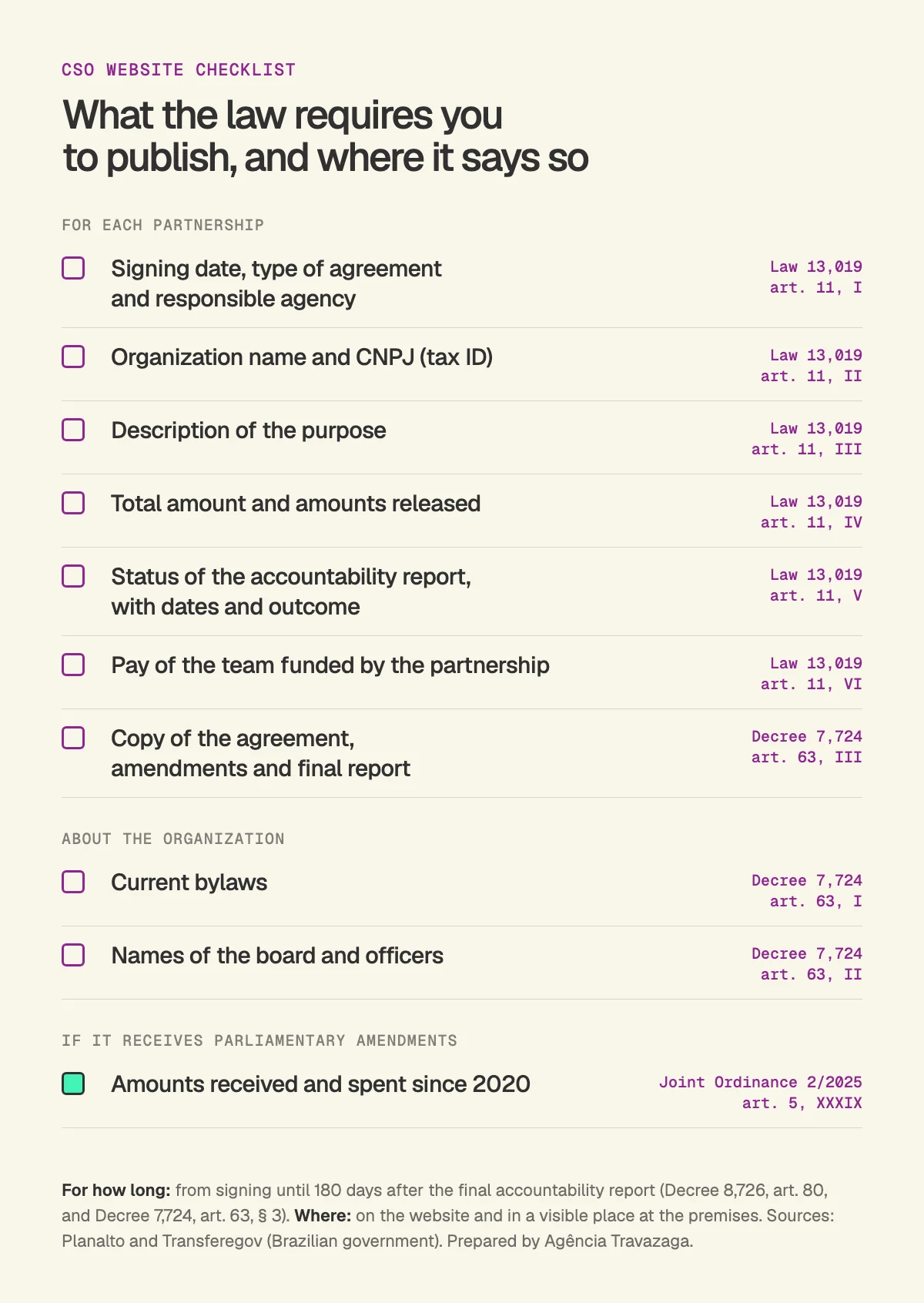
| Requirement | Rule |
|---|---|
| Every partnership listed | Law 13,019, art. 11 |
| Date, agreement and agency | Art. 11, I |
| Name and CNPJ | Art. 11, II |
| Purpose | Art. 11, III |
| Total amount and amounts released | Art. 11, IV |
| Accountability status | Art. 11, V |
| Team pay | Art. 11, VI; Decree 8,726, art. 42, § 4 |
| Bylaws and officers | Decree 7,724, art. 63, I and II |
| Copies of agreements and reports | Decree 7,724, art. 63, III |
| Amendments since 2020 | Joint Ordinance No. 2/2025, art. 5, XXXIX |
| How long it stays online | Decree 8,726, art. 80 |
| Notice board at the premises | Law 13,019, art. 11 |
The hard part is keeping all of this right over time. The amount released changes with each installment, the accountability status changes after the project ends, the board changes, and each new partnership joins the list. Information that only exists in a buried PDF or an old Instagram post counts as missing, because whoever audits needs to find it on the website without asking for help.
Want to know how many of these 12 requirements your organization's website meets today? The Transparência360 assessment checks the website item by item and shows what is missing. Talk to us to book it.
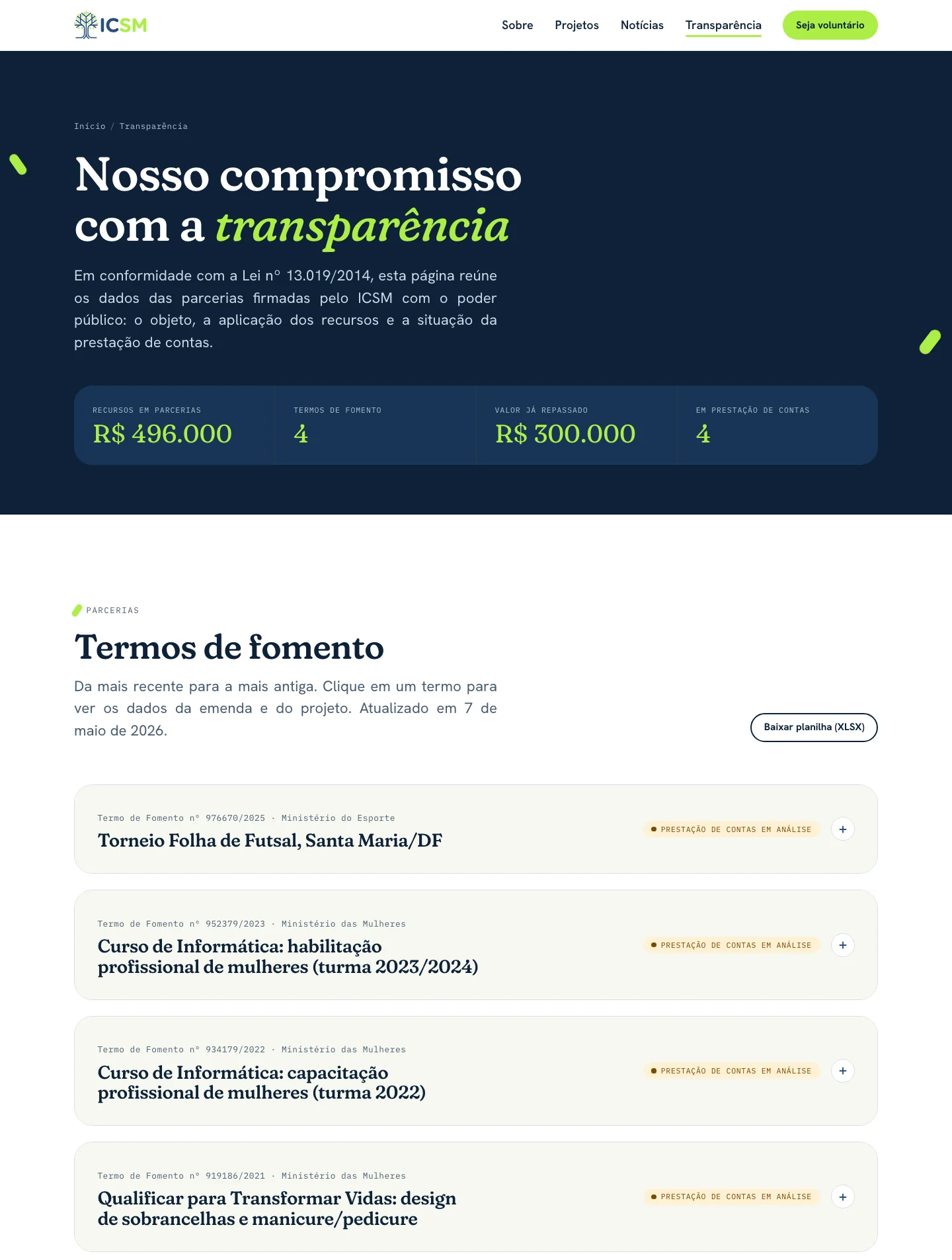
The ICSM transparency portal shows what this looks like live: the institute's four partnerships, totaling R$ 496 thousand in grant agreements, each with amounts, documents and accountability status.
Frequently asked questions
Does the law require a CSO to have a transparency portal?
The law requires the information to be online. The format is up to the organization. A portal helps because it gathers everything at one address the agency can open and check, but what meets the law is the content, published and up to date.
Does a cooperation agreement, with no money transferred, also have to be published?
Under the text of the law, yes. Article 11 covers all partnerships, and the cooperation agreement is one of MROSC's three forms of partnership. The amount items apply "when applicable", that is, when funds are involved.
Do we have to publish each team member's salary?
The law asks for the total pay, the roles and the pay planned for the fiscal year, when paid with partnership funds. In federal partnerships, Decree 8,726 asks for the amounts on an individual basis, together with the positions. Since this involves personal data, decide the format with your legal counsel.
Do states and municipalities follow the same rules?
Article 11 of Law 13,019 applies to partnerships with any level of government. The period online and any additional items come from each state's or municipality's decree and from the signed agreement.
Is a CSO without a website breaking the law?
Article 11 requires online disclosure and has no exception. Decree 7,724 lets a federal agency waive online disclosure, with a justification, when the organization lacks the means. Without that waiver in writing, the safe path is to have the page online.
Key takeaways
- Every CSO with a government partnership discloses it online and at a visible spot at its premises (Law 13,019, art. 11).
- The minimum per partnership: date and agreement, agency, name and CNPJ, purpose, amounts, accountability status and pay of the team funded by the partnership.
- In federal partnerships, bylaws, officers and copies of agreements and final reports are also required (Decree 7,724, art. 63).
- The federal period runs from signing until 180 days after the final accountability report. States and municipalities set their own.
- Organizations that receive parliamentary amendments publish the amounts received and spent since 2020, or the amendment may stall.
This article summarizes the law and the federal decrees as currently in force. Confirm with the funding agency and with your organization's legal counsel what applies to each partnership.
The next accountability report starts ready
The organization's own team handles its partnerships and accountability reporting. Travazaga builds what makes transparency, and every accountability report after this one, lighter: the NGO website, the Transparência360 transparency portal and the system integrated with Transferegov. Each partnership is published with its purpose, amounts, goals, documents and accountability status, at an address the agency can check. The history of past partnerships stays in the portal, so the team does not start from scratch with each new agreement. If your organization does not have a website yet, we build the NGO website with the portal built in.
Want to know what your organization still needs to publish? The assessment takes 15 minutes and is free.