Accountability checklist for Brazilian grant agreements
We read seven official manuals: 16 document types, only five in all of them. What each agency asks for in a grant agreement's accountability report.

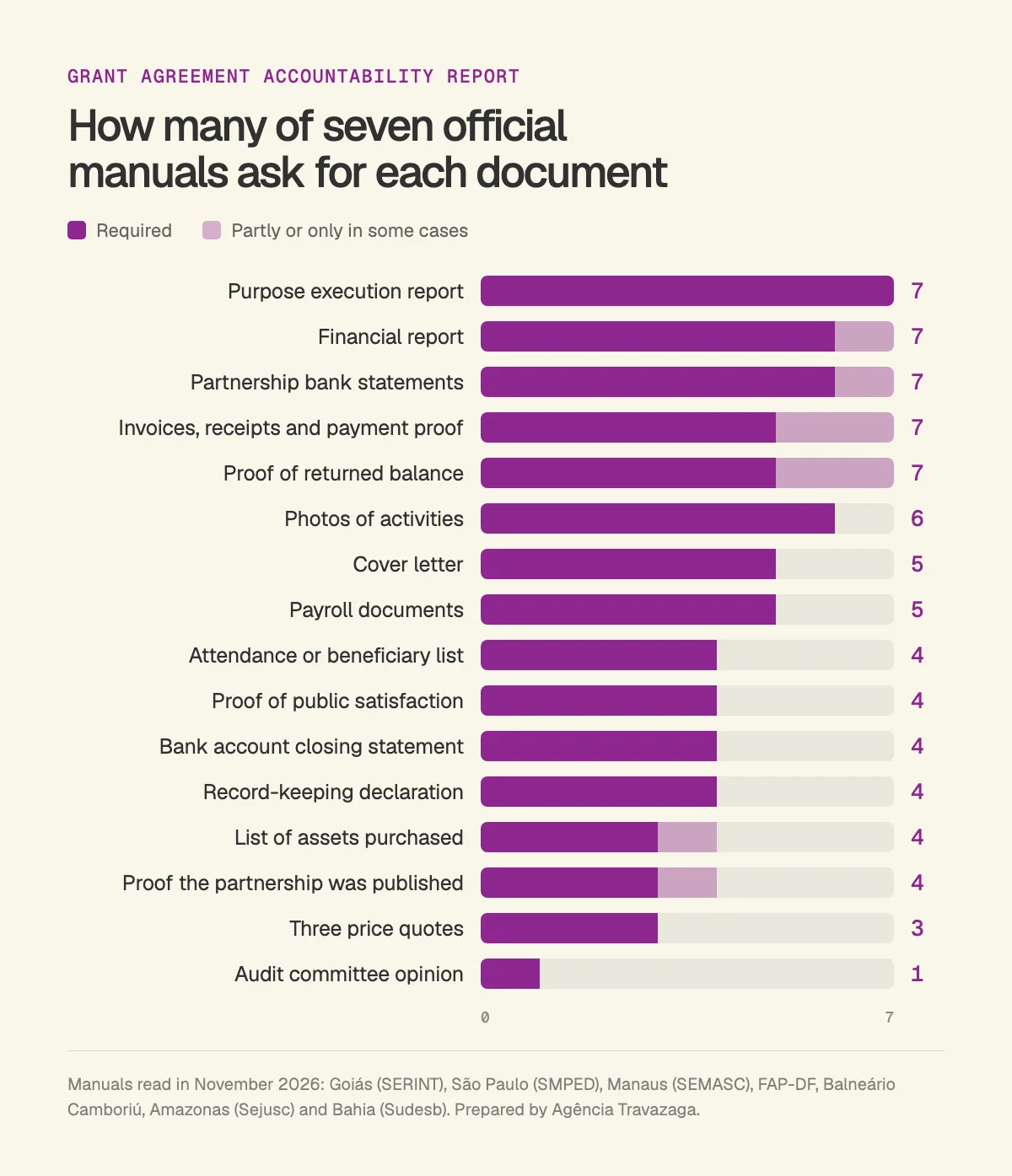
There is no single national template for the accountability report ("prestação de contas") of a Brazilian grant agreement ("termo de fomento"): the manual of the agency that signed the partnership is the one that counts. We read seven official manuals from states, cities and a public foundation, and five documents appear in all seven: the purpose execution report, the financial report, bank statements, invoices and payment proof, and proof that the unused balance was returned, some of them only in certain cases. Below are the full comparison and what it shows about how much work this takes.
Is there an official template for a grant agreement accountability report?
There is no national form. Law 13,019/2014, the Regulatory Framework for Civil Society Organizations (MROSC), tells each agency to give the organization (OSC) its own manuals when the partnership is signed (art. 63, § 1). That is why the same kind of agreement asks for different paperwork in Goiás, in Manaus or in the Federal District.
The law sets only the core: the purpose execution report, always, and the financial execution report when goals were not met (art. 66). For federal partnerships, the report is filed on the Transferegov.br platform, under Decree 8,726/2016. Deadlines, review and what happens if the accounts are rejected are covered in our guide to accountability reporting for OSCs.
Which manuals did we compare?
We downloaded and read in full seven official documents from different agencies in November 2026. When a manual has no year in its text, we list the date of the published file.
| Agency | Document | Year |
|---|---|---|
| State of Goiás (SERINT) | Accountability Manual for Grant Agreements | File from 2025 |
| City of São Paulo (SMPED) | Accountability manual for parliamentary amendments, collaboration and grant agreements | 2022 |
| City of Manaus (SEMASC) | Accountability manual for grant and collaboration agreements | 2023 |
| Federal District Research Foundation (FAP-DF) | FAPDF MROSC Accountability Manual | 2025 |
| City of Balneário Camboriú (Comptroller's Office) | Partnership Accountability Manual, 2nd edition | 2025 |
| State of Amazonas (Sejusc) | Accountability Manual for Sejusc partnerships | File from 2026 |
| State of Bahia (Sudesb) | Guidance for submitting the accountability report | File from 2026 |
What do the manuals ask for?
Of the 16 kinds of document that appear in the manuals, only five are in all seven. The table shows each one. "Partly" means the item appears inside another document or only in certain cases. "Not mentioned" means the manual does not mention it, which does not mean the agency waives it.
| Document | GO | SP | Manaus | FAP-DF | BC | Sejusc | Sudesb |
|---|---|---|---|---|---|---|---|
| Purpose execution report | Yes | Yes | Yes | Yes | Yes | Yes | Yes |
| Financial report | Yes | Partly | Yes | Yes | Yes | Yes | Yes |
| Partnership bank statements | Yes | Yes | Yes | Partly | Yes | Yes | Yes |
| Invoices, receipts and payment proof | Yes | Partly | Yes | Partly | Yes | Yes | Yes |
| Returned balance | Partly | Yes | Yes | Partly | Yes | Yes | Yes |
| Photos of activities | Yes | Yes | Yes | Yes | Yes | Yes | Not mentioned |
| Cover letter | Yes | Yes | Yes | Not mentioned | Not mentioned | Yes | Yes |
| Payroll documents | Not mentioned | Yes | Yes | Not mentioned | Yes | Yes | Yes |
| Attendance or beneficiary list | Not mentioned | Yes | Yes | Yes | Not mentioned | Yes | Not mentioned |
| Proof of public satisfaction | Not mentioned | Yes | Yes | Yes | Not mentioned | Yes | Not mentioned |
| List of assets | Yes | Not mentioned | Yes | Partly | Not mentioned | Yes | Not mentioned |
| Bank account closing statement | Not mentioned | Yes | Yes | Not mentioned | Not mentioned | Yes | Yes |
| Record-keeping declaration | Yes | Not mentioned | Yes | Not mentioned | Not mentioned | Yes | Yes |
| Proof the partnership was published | Partly | Not mentioned | Yes | Yes | Not mentioned | Yes | Not mentioned |
| Three price quotes | Not mentioned | Not mentioned | Yes | Not mentioned | Not mentioned | Yes | Yes |
| Audit committee opinion | Not mentioned | Not mentioned | Not mentioned | Not mentioned | Yes | Not mentioned | Not mentioned |
What does this comparison show?
Across the seven manuals there are 16 types of document, and only five appear in all of them. The other 11 depend on the agency: some ask for a cover letter, others do not mention it; some ask for three price quotes, others for an opinion from the audit committee; some require a record-keeping declaration, others a form closing the bank account.
For the OSC's team, that means the list for one partnership does not work for the next. An organization with one agreement with the state and another with the city works with two manuals, two formats and two submission rhythms at the same time. And the list still depends on the accountability clause of each agreement, which prevails over any generic template.
What changes from one agency to another?
The list changes, and so does the rhythm. These are the differences that change the team's work the most:
- Financial report always, or only on request. In São Paulo (SMPED), it is required only when the agency finds goals were missed, and it is signed by the legal representative and the accountant. In Manaus, at Sejusc and at Sudesb, it is part of every submission.
- Submissions during the partnership. SMPED asks for documents every quarter (within 15 days) and every half year (within 30 days), plus the final report within 90 days. Balneário Camboriú follows Normative Instruction TC-33/2024 of the Santa Catarina audit court and asks for a report after each transfer.
- Submission format. Manaus takes the report on a USB drive, in PDF/A, in a fixed sequence of 23 items. Sudesb takes it by email, one PDF per type of document. FAP-DF uses the Parcerias GDF platform and waives bank statements and balance receipts already on it.
- Formal details. Goiás asks for every invoice to be certified with the agreement number. Manaus asks for a sticker with the agreement number on every durable asset. Sejusc asks for "NADA CONSTA" ("nothing to report") on any attachment that does not apply.
- Deadline for the balance. Sejusc and Sudesb ask for the balance to be returned within 30 days after the agreement ends, before the report itself is due.
Does your organization have partnerships with different agencies, each with its own manual? Transparência360 brings all of the OSC's partnerships, municipal, state and federal, into one place, with the documents and accountability status of each one. Talk to us and tell us how your team works today.
What about federal partnerships?
In partnerships with the federal government, the template is Transferegov.br itself. The OSC files the purpose execution report on the platform, with proof of the goals such as attendance lists, photos and videos (Decree 8,726, art. 55). The agency pulls the financial report from the platform, and only when a goal was missed without justification or there is a sign of irregularity (art. 56).
The 2026 support material from the Ministry of Sport shows what this looks like in practice: attendance sheets, geotagged photos of materials and a monitoring form every three months, all sent during the partnership. The same material makes the release of parliamentary amendment funds depend on proof of transparency on the OSC's website, as ordered by the Supreme Court in ADPF 854.
Where does accountability reporting usually weigh most?
The manuals show where the work piles up:
- The form of each piece. Goiás asks for every invoice to be certified with the agreement number, and Manaus sets a sequence of 23 items in PDF/A. The agency checks the form as well as the content.
- Proof that has to exist on the day. A signed attendance sheet and a dated photo take minutes on the day of the activity and are hard to rebuild months later.
- Personal data. FAP-DF says attendance lists should not be made public and only images of people who gave consent should be shown, under Brazil's data protection law (LGPD). The team has to separate what goes to the agency from what goes on the website.
- Proof of publication. Manaus, FAP-DF and Sejusc ask for proof that the partnership is published. Sejusc wants the list of partnerships on the website for at least five years.
- Keeping records for 10 years. Law 13,019 requires original documents to be kept for 10 years, and four of the manuals ask for a declaration saying so.
To prove publication, the OSC needs a page the agency's manager can open. The ICSM transparency portal is an example of that page, with each grant agreement and its status.
Frequently asked questions
Can I use another agency's template?
It can work as a draft, but the submission follows the manual and the agreement of your partnership. The seven manuals we read use different forms even for the purpose execution report.
Is the financial report always required?
Under Law 13,019, only when goals were not met. In practice, six of the seven manuals we read include the financial report (or a statement of revenue and expenses) in the list of documents. Only São Paulo's SMPED leaves it for when the agency asks.
Can the attendance list go on the OSC's website?
The website shows the partnership, the amounts and the status of the accountability report. Lists with names and signatures of the people served stay in the report to the agency. FAP-DF states explicitly that they should not be made public.
Where do I find my agency's manual?
It should be handed over when the partnership is signed. If it was not, look on the website of the granting department, in the partnerships or MROSC section, and ask the partnership manager for the current version.
Key takeaways
- There is no national template: each agency provides its own manual when the agreement is signed (art. 63, § 1, of Law 13,019).
- Five items appear in all seven manuals we read: purpose report, financial report, bank statements, invoices and payment proof, returned balance.
- Photos, cover letter, payroll documents, attendance lists and the record-keeping declaration appear in most of them.
- The biggest differences are in rhythm (after each transfer, every quarter or only at the end) and in the submission format.
- Three of the seven manuals ask for proof that the partnership was published.
This summary compares manuals published up to November 2026. Check with the granting agency and with your organization's legal counsel what applies to each partnership.
The next accountability report starts ready
The organization's own team puts together the grant agreement's accountability report. Travazaga builds what makes this one, and every one after it, lighter: the NGO website, the Transparência360 transparency portal and the system integrated with Transferegov. Each partnership is published with its purpose, amounts, goals, documents and accountability status, at an address the agency can check. The history of past partnerships stays in the portal, so the team does not start from scratch with each new agreement. If your organization does not have a website yet, we build the NGO website with the portal built in.
Want to know what your organization still needs to publish? The assessment takes 15 minutes and is free.